
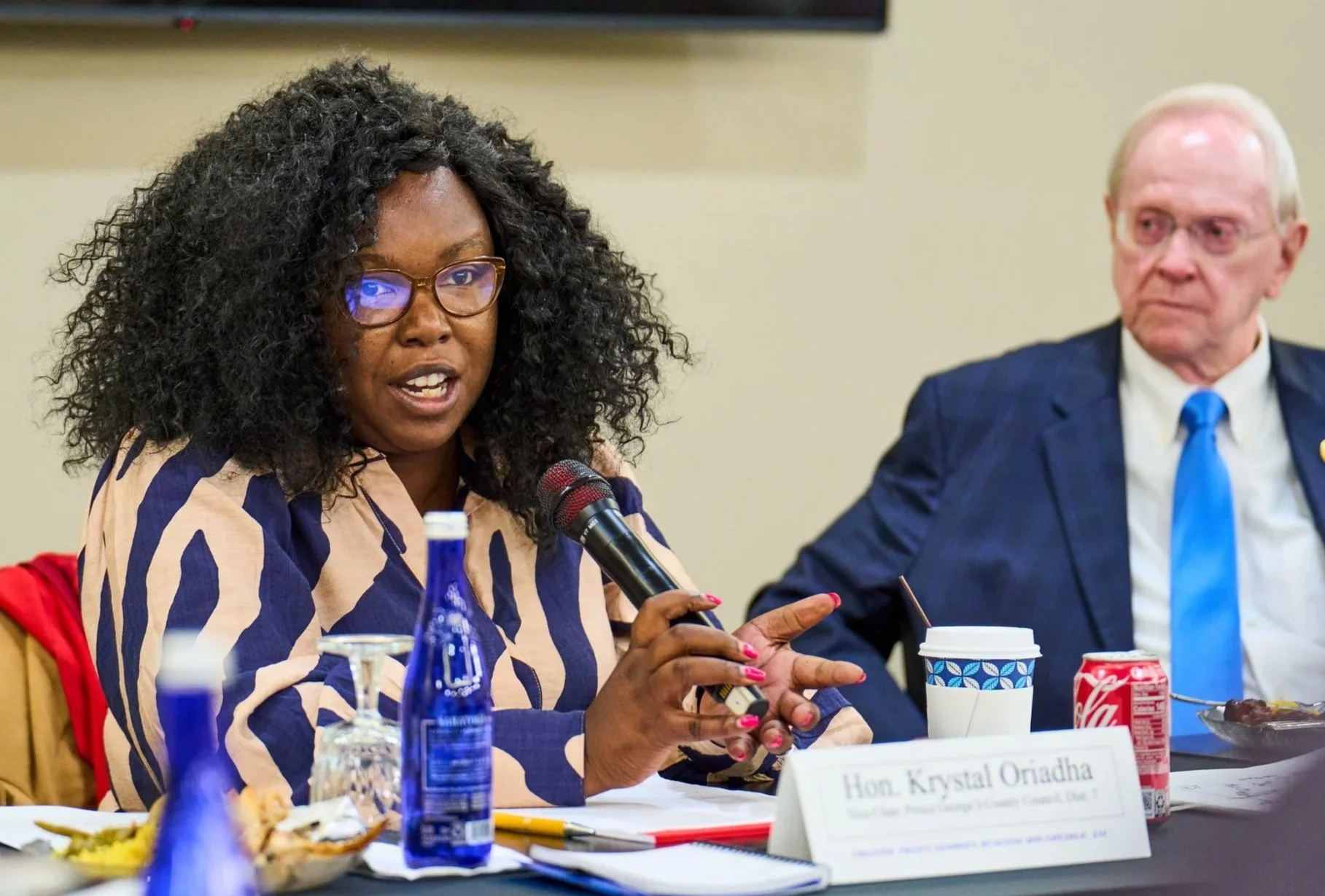
Oriadha Cites Business Partnering Goals
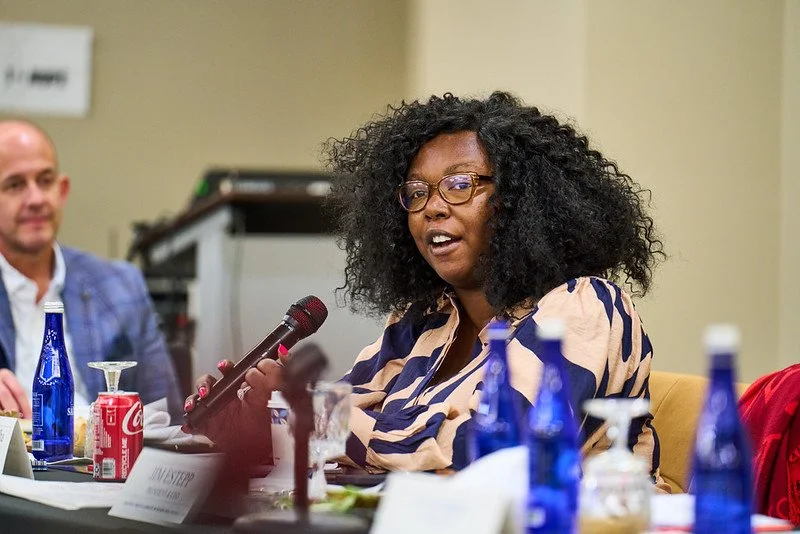
Oriadha
Compiled By Raoul Dennis // Photography By Amir Stoudamire
Just weeks before being named Prince George’s County Council Chair for 2026, District 7 Councilmember Krystal Oriadha made clear her vision for areas that could include partnering between county leadership and the business community.
The following are Oriadha’s remarks at the November 12 meeting of the Greater Prince George’s Business Roundtable:
“I’ll start off with some high vision goals and areas that are really important to me, but really want to leave space to hear thoughts, concerns, and ideas because my style of leadership is really collaborative in nature. I never think that I'm the smartest person in the room. I have a clear vision, but I think the worst thing a leader can do is have such a clear vision that they're not able to hear other perspectives and other ideas.
That's one of the reasons I started a development roundtable because development is not my expertise. I have a very advocate, community-centered perspective around development. My development roundtable is specifically for developers and lobbyists, and people that might have a very different opinion of mine. It's an opportunity for us to talk about where we can agree and where we can align because there might be areas where we're not going to agree.
I always tell people that if we sit down and talk about what we want for our community, I really believe that vision is the same. How we get there is where we work to figure out a compromise. I'm excited that two pieces of legislation came from that roundtable. It is really productive. Two bills came out of that and have passed from that roundtable.
If anyone is interested in meeting or being part of that roundtable, it is open and it's private because I know that there's some things people don't want to say under the scrutiny of the public eye. It's an opportunity for them to talk to me and see what we can do to move our community forward. Just some priorities that are important for myself and the chair, and the parties, I think that will really be leading us come next session.
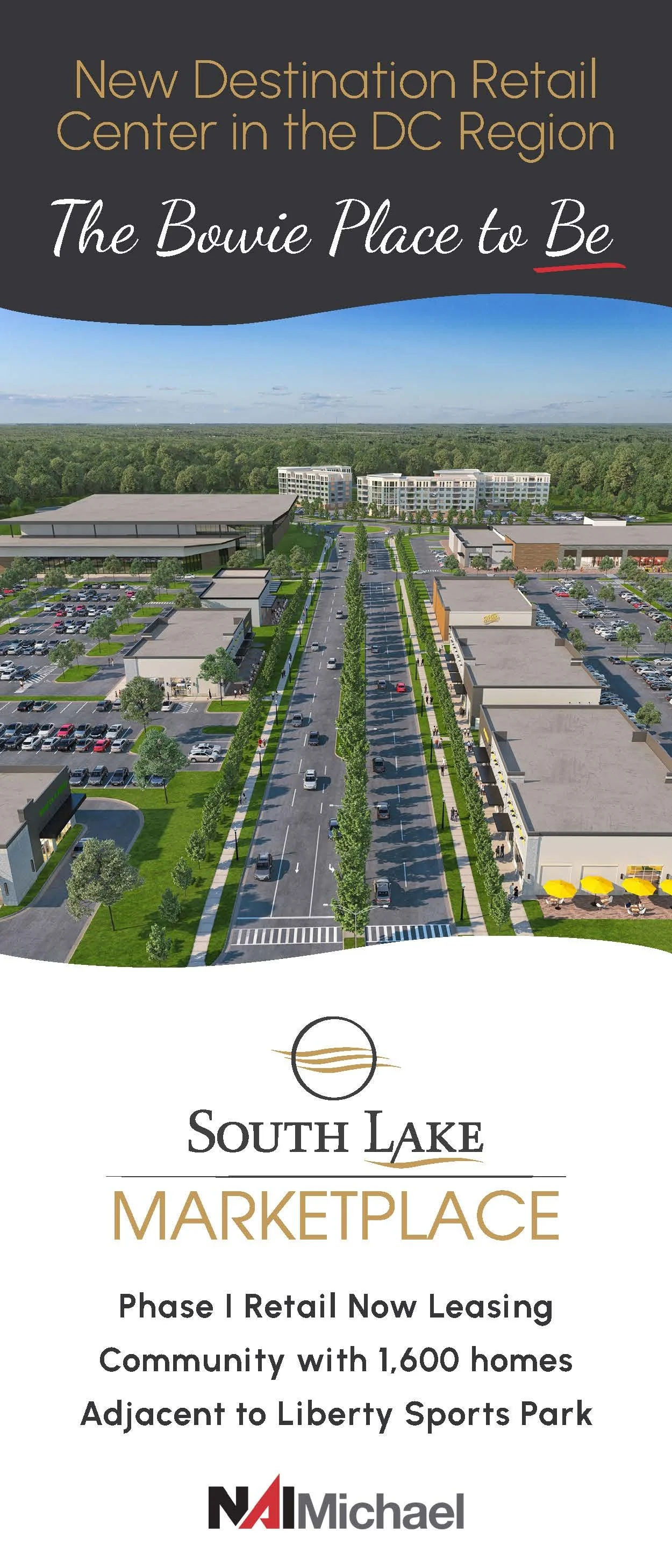
Economic development and building our tax base is probably the most important thing to me. When we look at the number one tax revenue that we have being National Harbor, we have to think about large-scale entertainment destination spaces.
I echo the sentiment that sometimes not everyone's going to see that vision. We're at $174 million deficit that's looking to grow to over $300 million by 2030. If we don't look at growing our revenue, we're going to be in a horrible position when it comes to the amenities that a lot of our residents want to see. Economic development is crucial.
One of the things I've heard most complaints about is the development, timeline process, and a lot of issues with permitting and DPIE. One of the pieces of legislation I want to do on day one of next session is all around streamlining the process and condensing areas of the development process, specifically with parking lanes. Where can we condense areas to shorten the timeline?
Then, [I’d also like to] look at incentives.
One of the issues we have is that we're really hamstrung by the state on what we can do around incentives. I was working on legislation, really trying to focus on restaurants in particular. We're meeting with the lawyers and we're going through the incentives and they're like, "Yes, the state says you can't do these things. You’ve got to go back to the state to get the authority."
Hopefully, Senator Watson will support us on this: One of our asks from the council is for us to have a broader economic development incentive scope that says if something's tied to an economic development priority for the county, that we have the flexibility to have incentives because we have a lot of incentives around housing, but we don't have as much as we need around entertainment development.
We hope to see that pass and give ourselves the ability to incentivize development in a way that we have not done historically. Another focus is looking at our current plan. One of the things I've committed to is a 2050 plan because there's a lot of tension points of where our plan currently stands, and the vision, and does it align, and the dates of a lot of our master plans. I've got a lot of buy-in from my colleagues that we can start the process, and the executive and administration for working on the 2050 plan.
As we know, we have flagship projects that we're looking at. One of the biggest issues I see with some of my colleagues and some of their legislation is I understand the vision and the issue, but I think it's band-aiding it. We have a lot of legislation that is piecemeal versus looking at the root, which is really the use tables.
I think if we take a step back and take some time to look at the use tables, we'll get at what some of my colleagues are looking at, seeing fast food and certain things they don't want to see coming in their community and feeling like they have no option. I think we can all agree on that. The problem is how do we fix it? I think there's some pieces of legislation that the developers see is too extreme, and then they leave an opening for it to be very dependent on who's elected, and it doesn't give us the stability that we want to see.
Then the other side where the community says, "We want to have a voice." My hope is that taking a step back to look at the use tables and looking at something that gives very clear definitions around when we say band-aiding, what does that mean? When we say these things, what does that mean, so that the development community has a clear picture of what we want to invest in, they have stability, our community feels like they're not going to get oversaturated with what they don't want to see.
Then I would say one of the big priorities for us as well is looking at how we can grow specifically our small minority-based businesses, in a way that I think we haven't historically done or invested. We have a couple of pieces of legislation that we've already passed around specifically looking at startup and expansion businesses that go inside of the Beltway, looking at small grant programs, looking at incubators outside of the ones that we currently have, like more in the northern part of the county and looking into the central and southern part of the county.
Something I think that's really important are set-asides. We are passing two pieces of legislation that really, before the way the legislation was written, is that, for example, if it wasn't a small minority business, that they could use any mix of local MBE. There was no minimum of like an MBE. We created a rule where it's saying a minimum of 15% of whatever makeup that you want to do has to include NBEs. It's trying to look strategically at the legislation that we have and the priorities that we have. We also are working on a pilot program with the county executive around moving our minority and small county-based businesses from subcontractors to prime.
We'll be creating a cohort model of asking five to 10 subcontractors that have never been a prime contractor on a development, investing $1 million in working with procurement, central services, and then an outside vendor on building their bonding capacity, helping them with all of the pitfalls that they might see and doing it in a targeted way.
One of the things we've heard as a complaint is that sometimes we'll have this broad goal, and if we just took a step back and worked really strategically with a small group of people for a set time, this would be an 18-month cohort, and then another 18-month cohort, we'd actually build the capacity of our small minority businesses. Then we're doing the same, not just for those businesses that are in development, but those businesses, no matter what your business is, if you're a caterer or in your fashion industry, whatever your business might be, we have another cohort. The goal is similar, five to 10 businesses.

The goal is for these businesses to be ones that have never made $1 million in revenue in one annual year, and then to bring them to $1 million. The goal is for them to have reached beyond the county. One of the problems we see is a lot of our businesses are relying specifically on county. What helps a lot of other businesses around the region is that they're not just confined to their jurisdiction. They get business across the boundaries here in the DMV and globally.
The goal is for them to expand beyond being dependent on county contracts. Those are, I would say, the top priorities when it comes to business and development is focusing on the process, the timeline, making it faster, focusing on the incentives that are different and unique. When I talk about incentives, automatic incentives are really important to me. I really want to get around all of the incentives having to come through a process of the county executive, then to the county council when we pass it. We really need to think about built-in, automatic incentives, that as long as you're meeting these criteria, you're automatically getting those tax incentives. I think that could be a game-changer around development in the county.