

Buying In Maryland, Building Prince George’s

Maryland Senator Nick Charles’ Push to Keep Billions of Dollars Close to Home
By Raoul Dennis
If only the millions of dollars per year that flow out of the state going to out-of-state contractors could be circulated in Maryland instead…if only…
In Prince George’s County, where cranes dot the skyline and new development continues to reshape communities from Largo to National Harbor, one stubborn statistic continues to trouble policymakers: only about 28 percent of the county’s tax revenue comes from commercial sources.
That figure has become a rallying cry for Nick Charles, the Maryland Senator representing District 25, who believes the solution to Prince George’s County’s long-standing revenue challenge may lie in a deceptively simple idea—spend more public dollars with businesses that are already rooted in Maryland.
His legislative proposal, the Buy Maryland, Buy Local Act (Senate Bill 943), seeks to change the way the State awards contracts by placing greater emphasis on economic impact rather than simply selecting the lowest bidder.
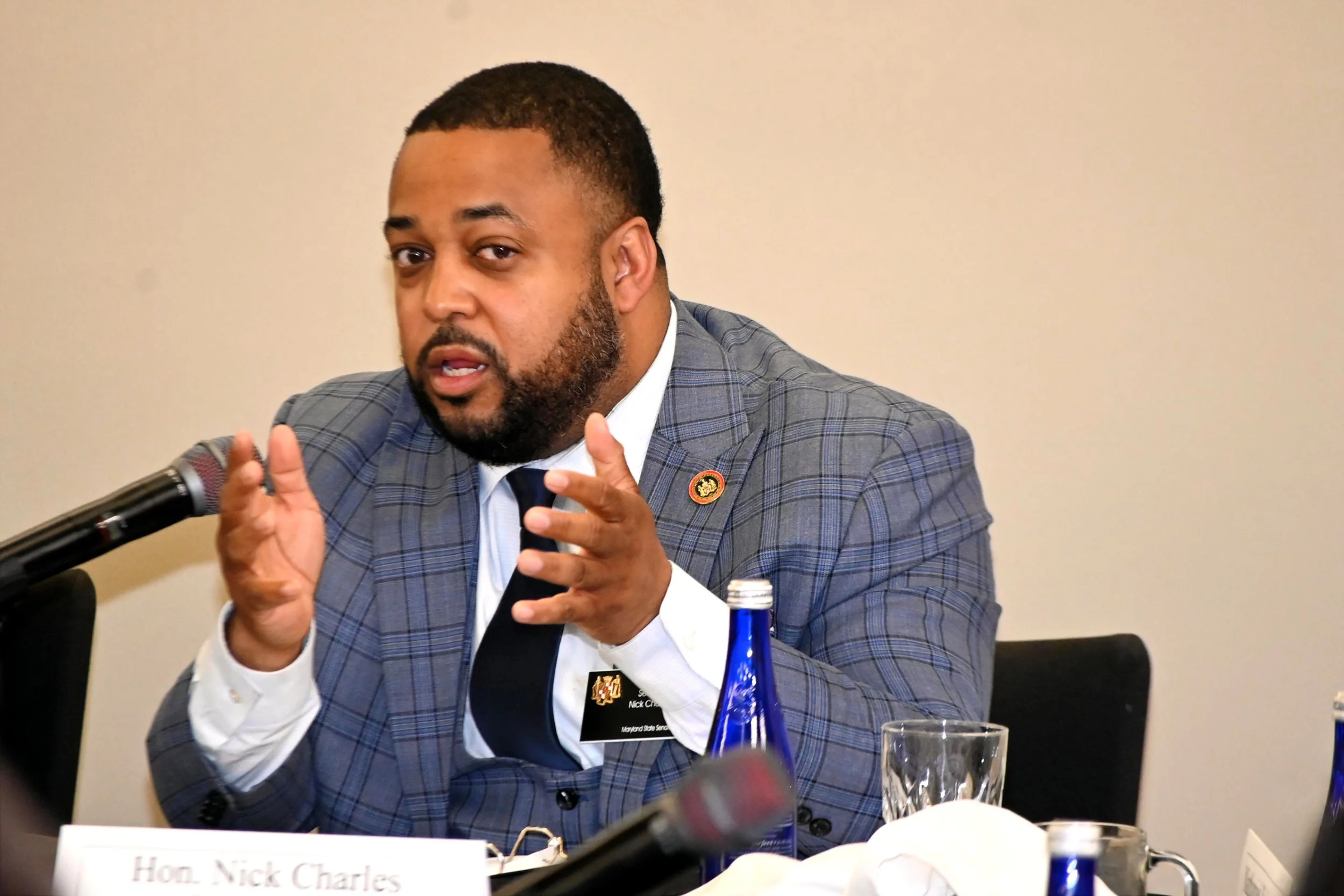
Senator Nick Charles
PHOTO: RAOUL DENNIS // PRINCE GEORGE’S SUITE MAGAZINE & MEDIA
For Charles, the measure is about much more than procurement policy. It is about economic self-determination.
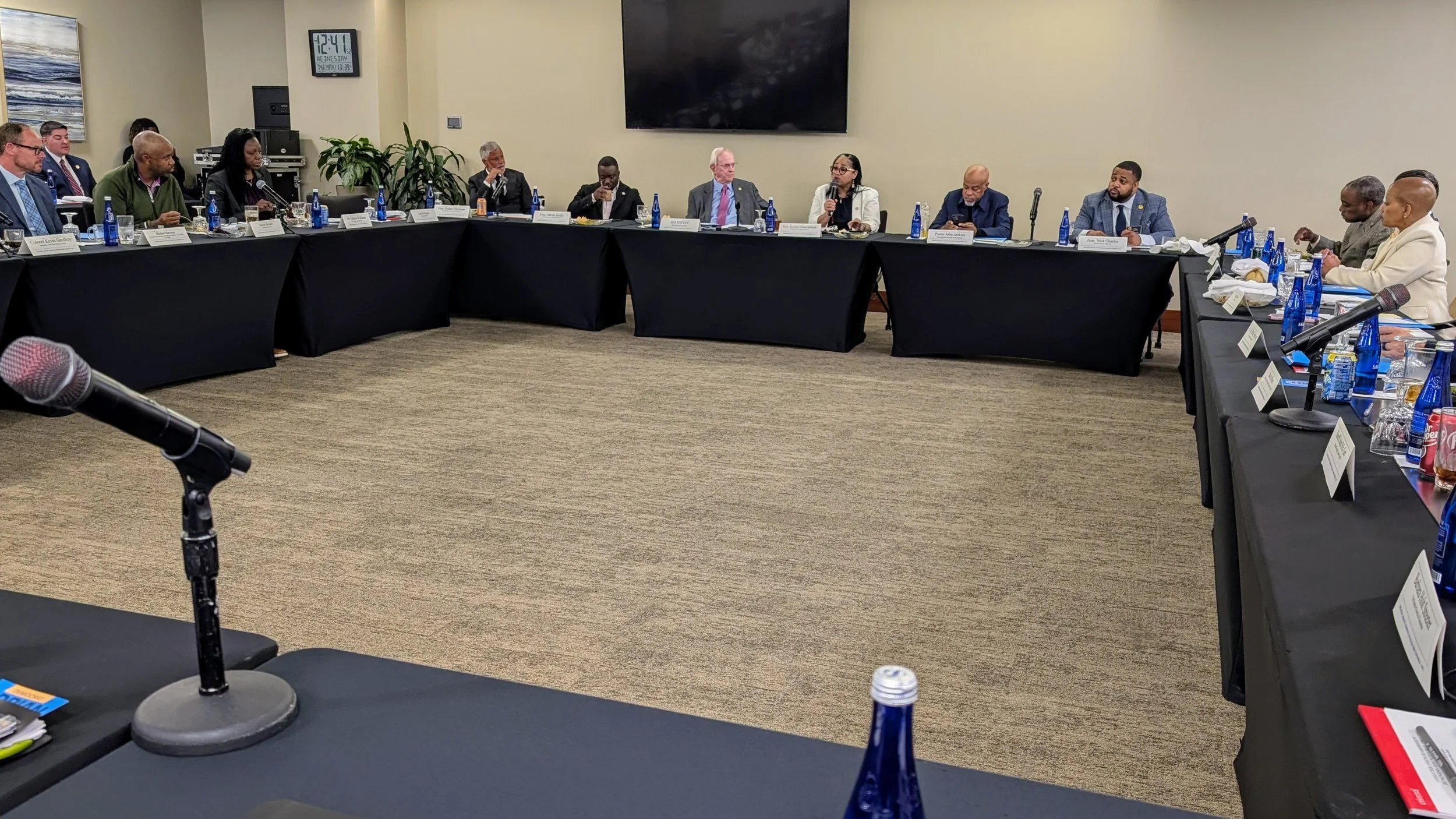
“If we truly want to make a mark and make an impact on increasing our tax base, we really have to start looking at how we’re dishing out Prince George’s County dollars,” Charles said in his remarks at the May 13 meeting of the Greater Prince George’s Business Roundtable.
His argument is compelling: if billions of dollars in contracts continue to flow to companies headquartered outside the county and outside Maryland, local businesses lose opportunities to grow, hire, and pay taxes where the work is being done.
And Prince George’s County, despite its extraordinary assets, remains caught in a fiscal paradox.
A County Rich in Assets, But Lean in Commercial Revenue

Prince George’s County is one of the most strategically positioned jurisdictions in the nation. Home to major federal agencies, Joint Base Andrews, University of Maryland, and MGM National Harbor, the county boasts an estimated $10 billion in annual contracting activity across government agencies, hospitals, utility companies, colleges, and regulated businesses.
Yet the county continues to face structural budget stress, including a deficit exceeding $170 million in recent years.
Charles believes the explanation is hidden in the outflow of procurement dollars.
“When you take the total value of all of the dollars they’re contracting out, and all municipalities, you’re roughly looking at about $10 billion,” Charles said. “Why are we at this budget shortfall? Why are we at 28%? Because dollars are leaving Prince George’s County, and they’re going to companies outside of Prince George’s County.”

The result is a local economy where residents earn strong incomes and consumer spending is robust, but too many institutional purchasing decisions enrich businesses elsewhere.
Maryland’s Small Businesses: The Economic Engine Under Pressure
Maryland’s small businesses are the backbone of the state economy.
The state is home to nearly 700,000 small businesses, representing more than 99 percent of all businesses statewide. Together, they employ over 1.3 million workers and generate approximately $13 billion in annual revenue.
These businesses range from family-owned construction firms and technology startups to neighborhood retailers, professional services companies, and food producers.
Maryland also ranks among the national leaders in minority-owned enterprises—an especially significant distinction for Prince George’s County, one of the most affluent majority-Black counties in the United States.
But despite this entrepreneurial strength, Maryland presents a difficult environment for small business growth.
According to data compiled by the Maryland Chamber of Commerce, Maryland ranks:
32nd overall in CNBC’s Top States for Business;
46th in cost of doing business;
46th on the State Business Tax Climate Index; and
7th among states with the highest combined state and local tax burden.
For small business owners, these rankings translate into real-world challenges: high taxes, rising labor costs, expensive real estate, and difficulty securing large public contracts.
Procurement as Economic Development
The Buy Maryland, Buy Local Act proposes a new philosophy: procurement should be treated as a strategic economic development tool.
Instead of awarding contracts based primarily on price, the legislation would require state agencies to use standardized evaluation criteria that place greater weight on economic factors, including job creation and the state and local impact of a bidder’s proposal. Bidders would also be required to submit economic impact statements detailing how their work would benefit Maryland communities.
In practical terms, this means a Maryland-based company that hires local workers, leases local office space, and pays local taxes could receive greater consideration than an out-of-state competitor offering a marginally lower price.
The bill’s small business impact was officially described as “meaningful.”
For Charles, the concept is common sense.
“For every dollar that we spend in another jurisdiction helping another company that’s not located in Prince George’s County, we’re constantly harming the people of Prince George’s County.”
Why the Bill Matters Even Though It Didn’t Pass
The legislation did not advance during the most recent session of the Maryland General Assembly.
Charles says he encountered significant resistance.
“The bill didn’t pass. We got a lot of pushback about this bill,” he said.
Still, the proposal has ignited an important conversation about how Maryland finances its future.
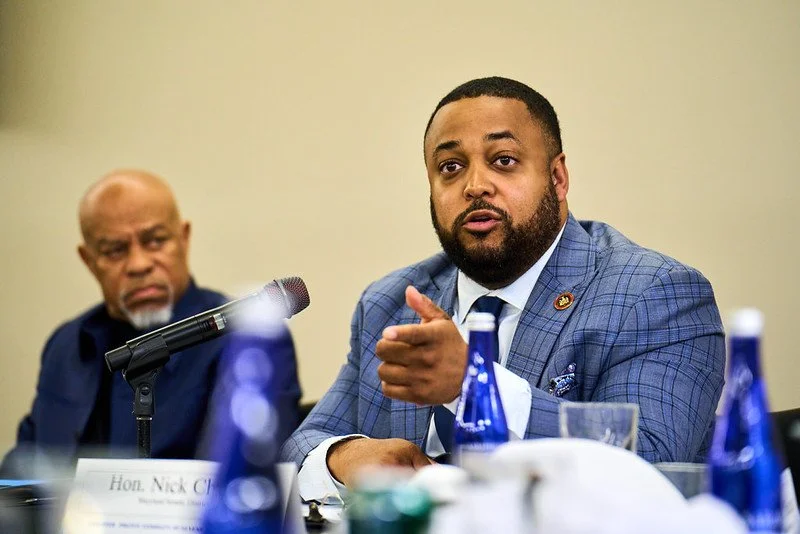
Nick Charles: “We truly have to, as a government, look at how we’re spending our resources.” PHOTO: AMIR STOUDAMIRE // PRINCE GEORGE’S SUITE MAGAZINE & MEDIA
The state continues to shoulder major obligations, including billions in education investments under the Blueprint for Maryland’s Future. At the same time, counties such as Prince George’s are searching for sustainable ways to strengthen commercial tax bases without placing additional burdens on homeowners.
Charles argues that smarter procurement can achieve both goals.
By keeping more contract dollars circulating within Maryland, governments can stimulate business expansion, create jobs, and generate additional corporate and property tax revenue.

The Multiplier Effect
Economists often describe local spending as having a multiplier effect. When a Maryland company wins a public contract, it hires workers, purchases supplies, rents office space, and pays taxes. Employees then spend their wages in local stores and restaurants, supporting additional businesses.
That cycle produces a ripple of economic benefits far beyond the original contract.
For Prince George’s County, where business leaders have long sought to raise the commercial share of the tax base, this approach could be transformative.
A stronger local procurement pipeline would help firms scale from small subcontractors to major employers. It would also create more opportunities for minority-owned businesses, one of Maryland’s greatest competitive strengths.
A Vision for Economic Independence

At its core, the Buy Maryland, Buy Local Act is about aligning public spending with public prosperity.
Rather than allowing billions of dollars to flow to companies with little long-term connection to Maryland, Charles wants taxpayers’ money to reinforce the communities that generated it.
“We truly have to, as a government, look at how we’re spending our resources,” Charles said.
In a county known for its talent, purchasing power, and entrepreneurial spirit, that message resonates.
Prince George’s County has the institutions, workforce, and ambition to become a far stronger center of commercial growth. What it needs, Charles argues, is a deliberate commitment to keep more of its economic value at home.
If future lawmakers embrace that vision, the next generation of Maryland small businesses may not merely survive in a challenging environment.
They may flourish—building wealth, expanding the tax base, and proving that where government spends its money can shape where prosperity takes root.