

Building A Worthy System
Dr. Shawn Joseph Ready to Author PGCPS’s Next Chapter, as Superintendent
By Raoul Dennis and Gil Griffin
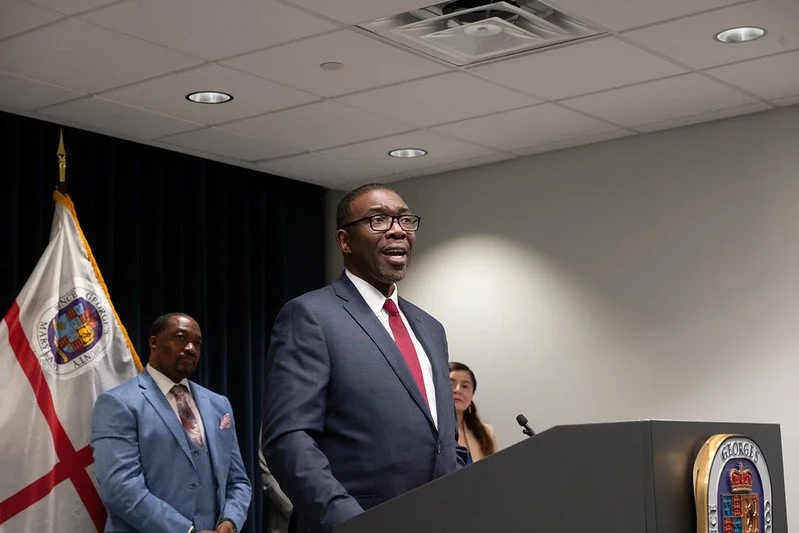
Standing calmly at the podium at an early June news conference to announce his selection as Prince George’s County Public Schools new permanent Superintendent, Dr. Shawn Joseph didn’t appear like a man relieved to have the “Interim” label removed from his title.
He radiated humility, devotion, and — in a few vulnerable moments, in which he held back, then wiped tears from underneath his glasses — emotion. But Joseph, the third PGCPS Superintendent in the last five years, and who has more 30 years of experience in education administration wasn’t tearing up over his and his team’s many accomplishments since County Executive Aisha Braveboy appointed him in July 2025 as Interim Superintendent.
He was reflecting about student achievement.
“Our seniors have earned more than $700 million in scholarships,” Joseph says. “It’s a declaration. It says doors are opening. It says futures are expanding. It says that when adults align around children, extraordinary promise can arise from every corner of this county.”
This moment was a far cry from a frigid November morning when Joseph and his team visited at Thomas S. Stone Elementary School, in Mt. Rainier. That building and about 50 other Prince George’s County public schools built in the 1950s, needs rebuilding or renovation because of structural flaws, ranging from outdated steam heating systems and mold accumulation to leaky roofs and gaseous odors coming through the piping.
But that challenge hasn’t deterred Joseph.
In January, he described his State of the Schools address as “a declaration of momentum,” as he advocated for equity for the county’s more than 130,000 students and their families. Joseph had history with PGCPS. From 2014 to 2016, he served as its Superintendent for Teaching and Learning. He championed literacy initiatives and increasing access to rigorous academic programs.
Before then, Joseph served as a district administrator in Montgomery County. After his first PGCPS stint, he was a superintendent of Metro Nashville, Tennessee schools, then was co-director of the Howard Urban Superintendent Academy at his alma mater, Howard University. But when Joseph returned to Prince George’s County in 2025, he faced a completely different landscape.

Rebuilding a Frayed Workforce
When Joseph was appointed Interim Superintendent, PGCPS had nearly 900 vacant teaching positions — more than any other Maryland county. Braveboy says PGCPS teachers and schools were at an impasse, as contract negotiations were stalled, and tensions were high. In his first 100 days in the post, Joseph initiated, “The Talent Commitment,” a three-phase initiative to stabilize the workforce. Today, Braveboy says, the results are tangible.
“Because of his leadership this year, teacher vacancies declined by 52 percent,” Braveboy says. “The impasse was gone within days of his tenure. He stepped into that moment with urgency, professionalism, and a commitment to collaboration.”
That included holding myriad and marathon negotiations with the Prince George’s Educators Association (PGCEA), the union that represents the county’s public school educators, as a yearly budget was being ironed out.
“[Joseph] set a tone from the beginning that we’re going to solve these problems and we’re going to solve them together,” says PGCEA President Dr. Donna Christy. “Finding $150 million without cutting jobs and laying anyone off, without defunding union contracts was not an easy task. But we were able to find the savings and get a budget together that works for everyone to the best extent possible.”
Joseph’s strategy to solve the vacancy crisis included recruiting candidates from local universities, including Bowie State and Howard, encouraging paraprofessionals to advance into teaching roles, building teaching mentorship networks, and rewarding high performing teachers with retention bonuses.
“It wasn’t about filling seats,” Joseph says. “It was about finding people who believe in our students.”
Listening First, Then Establishing Transparency
Joseph also started his tenure with open ears.
He immediately held 20 different community meetings as part of what he called the “100 Meetings in 100 Days Tour.” Joseph’s new team met with everyone connected with PGCPS — students, families, families, custodians, clergy, in every corner of the county.
Joseph asked the same question to open each exchange: “What does a better school look like to you?”
The answers shaped Joseph’s evolving blueprint for PGCPS’s future.
“He listened to his teachers,” Braveboy says. “He listened to the administrators. He listens to parents. He listens to everyone who cares about our school system and has something to contribute. And he sees the ability for everyone to impact the school system in a positive way. He wanted to humble himself to his new role.”
Academic Excellence Meets Innovation
As Joseph worked to re-establish trust between PGCPS and families, his administration reinstated successful past programs and created new ones.
District literacy coaches were re-hired. The Advanced Placement access was expanded, and Joseph’s team launched a cross-departmental initiative called the Center for Innovative Learning, which explores new models for integrating STEM (Science, Technology, Engineering and Mathematics) courses, arts instruction, and building career pathways into the curriculum. Technology has also been of Joseph’s focus areas. His team created virtual dashboards to display students’ skill levels in reading and mathematics.
Still, there was at least one major hiccup.
By the end of September in the 2025-26 school year, PGCPS didn’t meet state requirements to have the necessary number of students immunized. Not hitting that deadline jeopardized losing $20 million in state dollars. By mid-November though, PGCPS remedied the issue, which, Joseph says, “dramatically saved us valuable dollars that we just can't afford to lose.”
When the 100 days ended in October 2025, Joseph said then that he and his team accomplished “about 90 percent” of their goals. As for the remaining 10 percent, Joseph says, “some things just need more time and some things are cost-prohibitive, but we'll complete them all.”

The Challenge of Shifting Demographics
Joseph says PGCPS having 40 percent of its students who are immigrants and don’t speak English as their first language has presented new challenges.
“When you test those students in reading and mathematics, they're not going to perform at standard,” says Joseph, himself the son of immigrant father originally from the Caribbean island of Antigua.
“Even if they grow one year, the fact is, to hit proficiency, it’s only through accelerating growth that we are going to hit it, change the trajectory and move us forward.”
Joseph’s father started his professional life as a tradesman who later became a chef. Joseph’s mother — a building services worker — grew up in rural Georgia. Joseph is the first person in his family to graduate from high school.
“I understand what it's like to grow up in poverty,” Joseph says. “People still crave the basic desire to be seen, to connect, and have hopes and dreams for themselves and for others. I take that with me.”
Battling Setbacks and Confronting Dilemmas
Before Joseph’s appointment, dual enrollment for PGCPS students wanting to simultaneously take tuition-free courses for college credit was a difficult issue.
Joseph says his team has addressed it by ensuring students at all 25 PGCPS high schools can now take online courses at Prince George’s Community College. He adds that families can save some $10,000 in college tuition costs.
“Access is important,” Joseph says, “because for many of our families who don't have resources, the ability to travel from one part of the county to the next can be very difficult.”
“Research shows that kids who take college credits and pass those courses are more likely to go to college and know that they can achieve in college,” Joseph says. “Our kids will know whether college is for them.”
Joseph says more heavy lifting remains.
He says the PGCPS strategic plan, scheduled to be released in July, will focus on building capacity, reading and mathematics, and the ramping up of literacy coaching.
“We face real fiscal, operational, and instructional challenges,” Joseph says, “but we’ll meet them with honesty, discipline, transparency, and unity. Our children are not waiting to become brilliant; they already are. Our responsibility is to build a system worthy of that truth.”