
Braveboy Places Moratorium on Detention Centers
County Executive Unveils Logo Designating County Properties, Lots and Garages as Safe Spaces
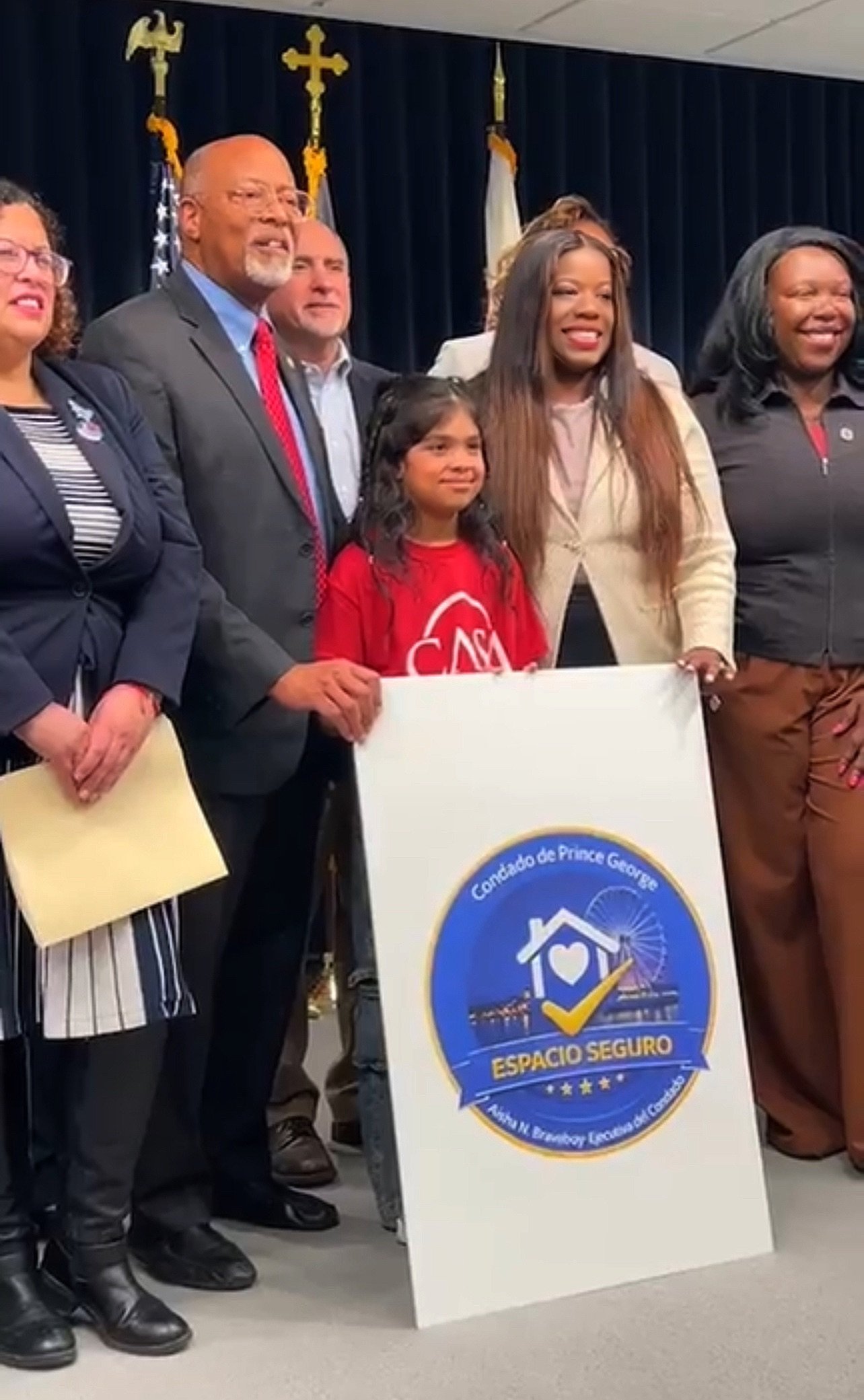
In a packed government hearing room in Largo on February 19, Aisha Braveboy stood flanked by members of the County Council, municipal leaders, representatives from “We Are CASA,” and immigrant advocates to deliver a message she described as both moral and urgent.

With the stroke of her pen, Braveboy signed Executive Order No. 9-2026, establishing an immediate moratorium on any proposal seeking to use property in Prince George’s County as a detention center. The action comes amid heightened immigration enforcement across Maryland and follows mounting concerns from residents, business owners, and faith leaders.
Standing beside her was Glenn Ivey, who recounted visiting a federal detention facility in the state. “The animal shelters in Prince George’s County are better maintained than the ICE detention centers,” Ivey said, sharply criticizing the conditions he observed and raising questions about detainee treatment.
The announcement resonated deeply in a county where immigrants—particularly Latino immigrants—are woven into the social and economic fabric. Prince George’s County is one of the most diverse jurisdictions in Maryland, with immigrants representing roughly one in five residents. Latino residents account for approximately 20 percent of the county’s population, with especially vibrant communities in Hyattsville, Langley Park, Mount Rainier, Riverdale Park and Bladensburg.
In the City of Hyattsville alone, Latino residents comprise more than 40 percent of the population, contributing to a thriving corridor of international grocery markets, restaurants, construction firms, landscaping companies and small retail shops. Spanish is commonly heard in schools, churches, and municipal meetings. Cultural festivals fill town squares, and immigrant entrepreneurs have transformed once-struggling commercial strips into bustling centers of commerce.
Yet in recent months, fear has crept into those same corridors.
“Residents are being told to beware of visiting international grocery markets,” said At-Large Councilmember Wala Blegay during the press conference. “We want residents to know, do not be afraid. We are here to help you.”
Braveboy unveiled a new county logo that will designate government buildings, garages and parking lots as safe spaces—echoing the longstanding sanctuary offered by churches and schools. The visual marker is intended to reassure families that county facilities will not be used as staging grounds for detention.
The most emotional moment came when City of Mount Rainier Mayor Celina Benitez introduced 10-year-old Liliana Ramirez. In a steady but soft voice, the Prince George’s County resident recounted how her father was detained at his construction job site two days before the new year. Her family has not seen or heard from him since.

Her story, Braveboy later said, underscored the human toll behind policy debates.
Braveboy acknowledged Liliana’s bravery and the parallel story they shared in that they were both born in America, although their fathers were not.
“I am the daughter of an immigrant. My father came to this country in pursuit of the American Dream,” the County Executive said. “The disregard for human life will not be tolerated in Prince George’s County. Not today. Not tomorrow. Not ever.”
Prince George’s immigrant community is not only a cultural cornerstone but also a powerful economic engine. Latino-owned businesses generate hundreds of millions of dollars in annual economic activity in the county. Immigrant workers are heavily represented in construction, hospitality, healthcare support, food services, childcare and transportation—industries that underpin the region’s growth. Many are taxpayers, homeowners and small-business operators who reinvest earnings locally, supporting commercial rent rolls and property tax bases that fund schools, public safety and infrastructure.
Business leaders note that when immigrant families retreat from public life out of fear, the economic ripple effects are immediate: fewer customers in shops, fewer workers reporting to job sites, and reduced sales tax collections.
At the same time, county officials emphasized that public safety remains a priority. Prince George’s County has reported a decline in violent crime over the past year, part of a broader regional trend. Homicides and carjackings have decreased, and law enforcement leaders credit coordinated policing strategies, community engagement initiatives, and youth intervention programs. County officials argue that community trust—especially within immigrant neighborhoods—is essential to sustaining those gains.
When asked whether her executive order risked antagonizing federal immigration authorities, Braveboy did not hesitate.
“The time is always right to do the right thing,” she said. “To think or believe that if we just say nothing, we’ll get overlooked? I don’t think that’s the right strategy.”

Gang Activity in Context: Facts Over Fear
Historic reporting has documented the presence of transnational criminal organizations such as MS-13 in the wider Maryland region, including arrests and prosecutions connected to violent offenses in earlier years. However, law enforcement and advocacy leaders stress that such cases represent a tiny fraction of overall crime in the county and that conflating immigration status with criminality harms community trust and effective policing.
Past estimates from law enforcement initiatives once identified roughly 400 gang members locally across all affiliations, with Hispanic/Latino crews among dozens of groups, though comprehensive updated rosters are not publicly released for security and investigative reasons. Local police departments work closely with federal and state partners to disrupt violent crime networks while investing heavily in prevention and intervention.
Neighbors, Not Outsiders
For many in attendance, the moment reflected more than a policy dispute. It signaled a broader debate about identity, belonging and economic stability in one of Maryland’s most diverse counties.
As families filed out of the building, some wiping tears, others exchanging determined embraces, the message was clear: Prince George’s County sees its immigrant residents not as outsiders, but as neighbors, workers, taxpayers and contributors to a shared future.
County leaders say that the future will not include detention centers on local soil.